Ariadne – a new chapter for Modell Aachen and orgavision!
Discover Ariadne

"We want to map our end-to-end processes." You’ve likely heard this phrase more and more over the last few years—in meetings with management, process owners, or IT teams. Yet, the meaning of the term varies. Some use "E2E" to refer to the company's entire process management, while others apply it to a single cross-departmental workflow. Many simply drop the buzzword because it’s trendy. That is why, when discussing end-to-end (E2E) processes, it is essential to ensure everyone is on the same page.
Before you dive into how to effectively map E2E processes within a management system (which we will cover in the second part of this series), it is worth taking a step back: What exactly is an end-to-end process, what isn't – and why is this topic gaining so much momentum right now?
The term originates from Business Process Management (BPM) and describes a process that runs "from end to end"—from the initial trigger to the final result, without stopping at departmental boundaries. In professional literature, an E2E process is described as the sequence of all activities required to provide a service to a customer that fulfills a specific need, including all necessary resources.1 Crucially, "customer" refers to both external and internal customers. This means that purely internal workflows can also be end-to-end.
A second, very concise definition hits the nail on the head: End-to-end characterizes a value-adding process that is initiated by a customer and ends with a customer without any process breaks, even though it may pass through various business units along the way.2 The common denominator of both definitions is continuity: an E2E process follows the flow of value, not the organizational chart.
From these definitions, we can derive five characteristics that reliably identify an E2E process:
Just as important as defining the term is knowing what it excludes: not every process is truly end-to-end. A single process without preceding or subsequent steps does not qualify, nor does a simple activity description like "How to fill out this form." While the latter has its value, it belongs at a more granular level. Similarly, a sub-process that is not embedded in a larger chain cannot be considered an E2E process. A simple rule of thumb: if someone is describing activities in detail, it is not E2E. If, however, an entire chain from trigger to result is visualized at a high level, you are at the right altitude.
A proven framework shows what an E2E process looks like in concrete terms: in practice, almost every company – regardless of industry – can be described using these five generic, cross-business-model end-to-end processes.
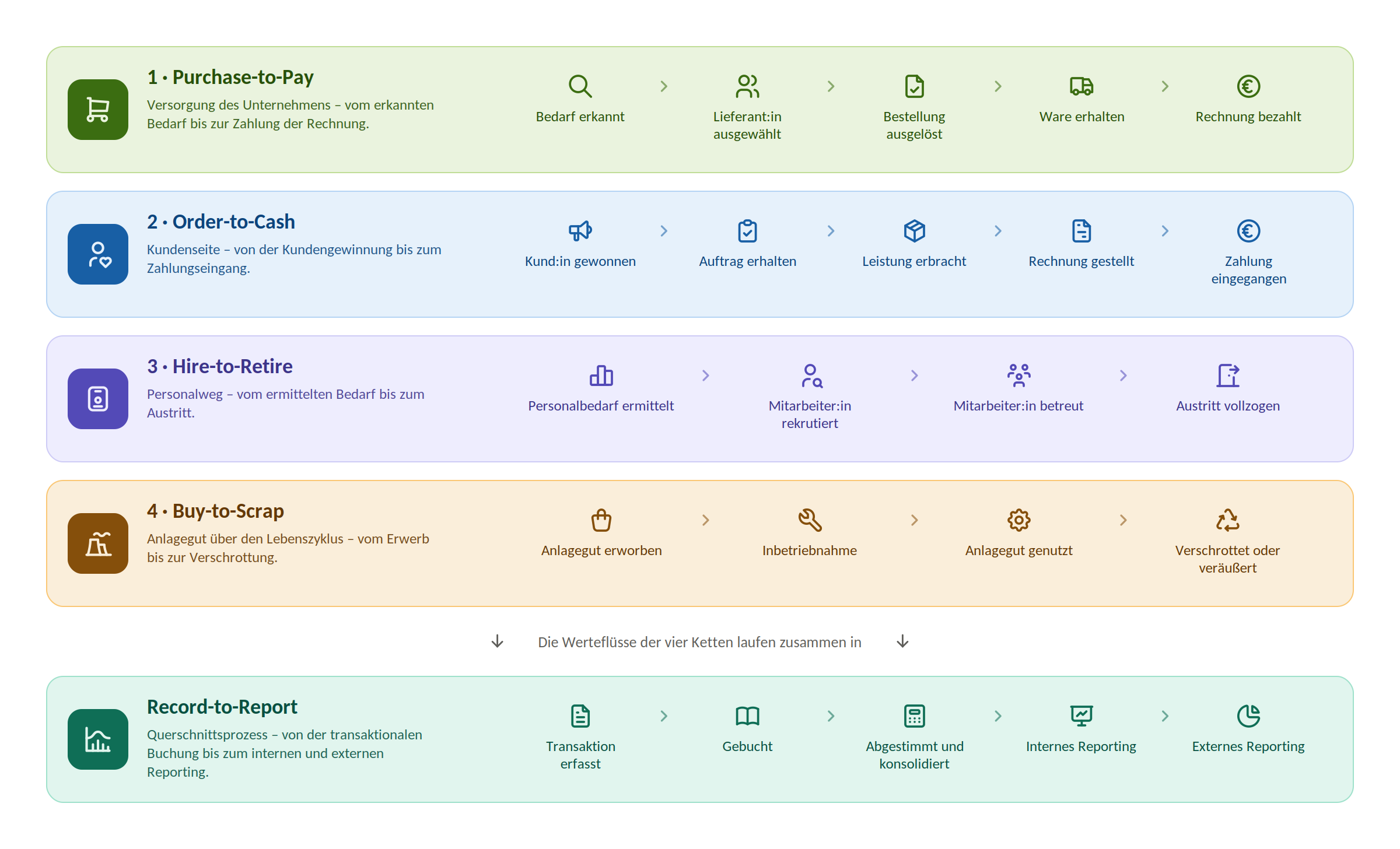
The Purchase-to-Pay process covers the company's supply chain: from identifying a need and selecting a supplier to ordering and paying the invoice. Its counterpart on the customer side is Order-to-Cash – from customer acquisition and order placement to service delivery and payment receipt.
Hire-to-Retire maps the employee lifecycle, from identifying staffing needs and recruiting to ongoing support and offboarding. Buy-to-Scrap tracks an asset from acquisition through commissioning and usage to its eventual disposal or sale.
A special role is played by Record-to-Report : This financial process extends from individual transactional entries to final internal and external reporting. As a cross-functional process, it is where the value flows from the other chains converge. It serves as a prime example of how E2E processes can overlap.
These five processes cover the core of E2E, but they are not a rigid framework. Depending on the business model, specific chains are added – production is a particularly clear example of this: A mass producer manages its value creation as Make-to-Stock (production for stock), an automotive manufacturer more as Make-to-Order (order-based production), and large-scale plant engineering as Engineer-to-Order (customized design). Which E2E processes a company truly needs therefore depends on its industry, business model, and structure. The framework provides orientation, while the specific design is tailored individually.
E2E processes are not a new concept – what is new is the pressure currently pushing the topic onto the agenda. This is driven primarily by two forces. The first is digitalization. Focusing on end-to-end processes has proven to be a suitable approach for consistently and seamlessly integrating digitalization with operations. Anyone looking to automate processes, integrate systems, or implement an ERP must consider how data and tasks relate across system boundaries. The E2E perspective provides exactly this end-to-end view. It is no coincidence that IT, process management, or corporate development are often the ones driving this topic forward.
The second force is the strong desire to break down silos within the company. Most friction losses do not occur within a department, but at the interfaces between them, where responsibility shifts, information is lost, or system breaks occur. E2E processes make these transitions visible – and thus collectively optimizable. The goal is to move away from the sub-optimization of individual parts toward the overall optimization of the entire chain.
So, before you map out an E2E process, it is worth clarifying the fundamentals. You should internalize three things:
And perhaps the most important piece of practical advice: E2E processes cannot simply be recorded; they must be preceded by a shared understanding. Before anything is modeled, the company should clarify what the stakeholders actually mean by E2E and what is intended to be managed with it. Creating a common language saves many discussions later on.
With that, the foundation is laid! How to turn this understanding into a concrete representation in the management system, where E2E processes live, how to link them with existing process descriptions, and how to properly scope processes for this purpose will be covered shortly in the second part of this article series.
Deep dive:
1cf. Bergsmann, S. (2012): End-to-End-Geschäftsprozessmanagement. Springer, Wien.
2cf. Gaydoul, R. / Daxböck, C. (2011): Prozessmanagement von End-to-End Prozessen. In: ZfCM – Controlling & Management, Special Issue 2/2011, p. 40–46
Sign in to get in touch with Carsten directly.





We are happy to provide you with inspiring content, current events and news.